
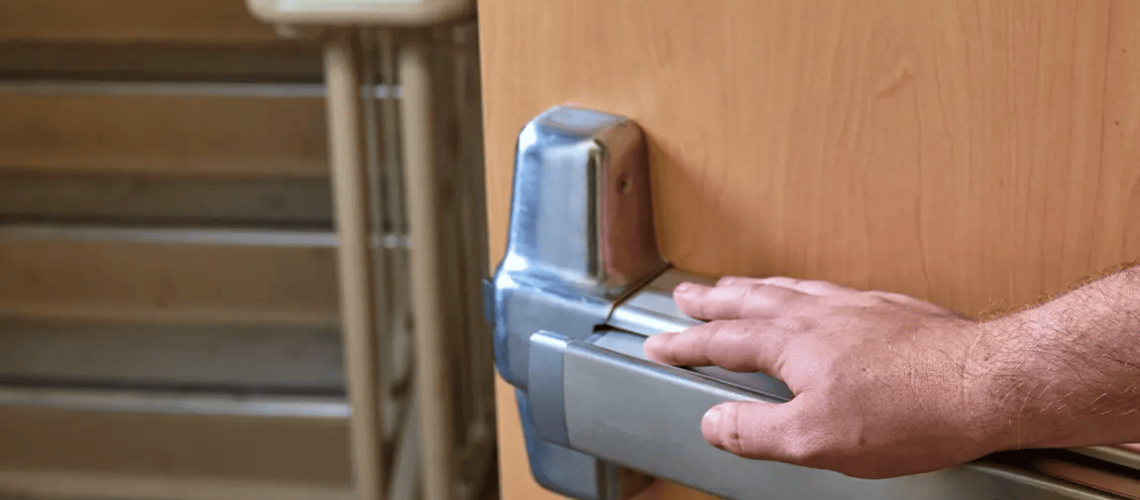

A report by the International Code Council highlights that 75% of fire rated doors fail to meet operational standards due to improper maintenance or installation. This gap in functionality raises serious concerns about building safety.
What Fire Doors Actually Do
Fire doors are engineered, tested, and rated assemblies meant to prevent the spread of fire and smoke between areas, providing safe egress and protecting property. The doors are rated for fire resistance (duration for which the door can withstand fire) and are used as a part of passive fire protection (Cambridge Dictionary).
Passive Protection
Fire doors are the first line of defense and referred to as passive protection because they work without human intervention, as long as they are maintained properly.
Misuse of Fire Doors
The real danger isn’t missing fire doors, it’s having ones that look compliant but fail when it matters. Some inspectors report 50-80% failure rates due to poor installation/maintenance (National Fire Escape Association). NFPA 80 requires that fire doors be inspected and tested immediately after the initial installation and then at a minimum, annually after that. Fire doors must be kept closed and latched or arranged to be automatic closing during the time of a fire.
Human Behavior
The most common fire door failure isn’t mechanical, it’s human. Property owners have a number of reasons as to why they keep their fire doors opened, a few examples could be:
- Distribution of heating or air conditioning
- Ease of movement
- Tenants moving in or out of the building with multiple trips
- Carrying loads/objects with no impediment
According to the NFPA, public fire departments responded to nearly 1.4 million building fires in 2021. When fire doors are kept open for any reason, there is a much greater potential for loss of life.
Mechanical Failure
Regular inspections per NFPA 80, are key to ensuring safety and security. Just because it looks fine to you, doesn’t mean it works in a fire. Common issues for the mechanics of a fire door:
- Misalignment
- Faulty Doors
- Damaged Seals
- Loose Hinges
All these mechanical issues leave gaps for smoke and fire to get through. A fire door that doesn’t close fully or latch is no longer a fire door, it’s just a door.
Code and Compliance
Fire doors are regulated for a reason: because one failed opening can compromise an entire fire barrier. The annual inspection of a fire door needs to be completed by a qualified person who has knowledge and understanding of the operating components and type of door being tested. NFPA 80 specifies 13 critical inspection points that must be verified during each inspection.
- Labels are clearly visible and legible
- No open holes or breaks in surfaces
- Glazing and vision light components are intact
- All components are in good condition
- No parts are missing or broken
- Clearances meet requirements
- Self closing device works properly
- Positive latching device functions
- Coordinator is operational (double doors)
- Gasketing and seals are intact
- No auxiliary hardware interferes
- No field modifications have been made
- No obscuring signs or decorations